
Overview
- What? One of Bursa’s oldest and largest mosques. The word “Ulu” translates to “great” or “grand.”
- Where? Located in the city center of Bursa, in Turkey’s Marmara region.
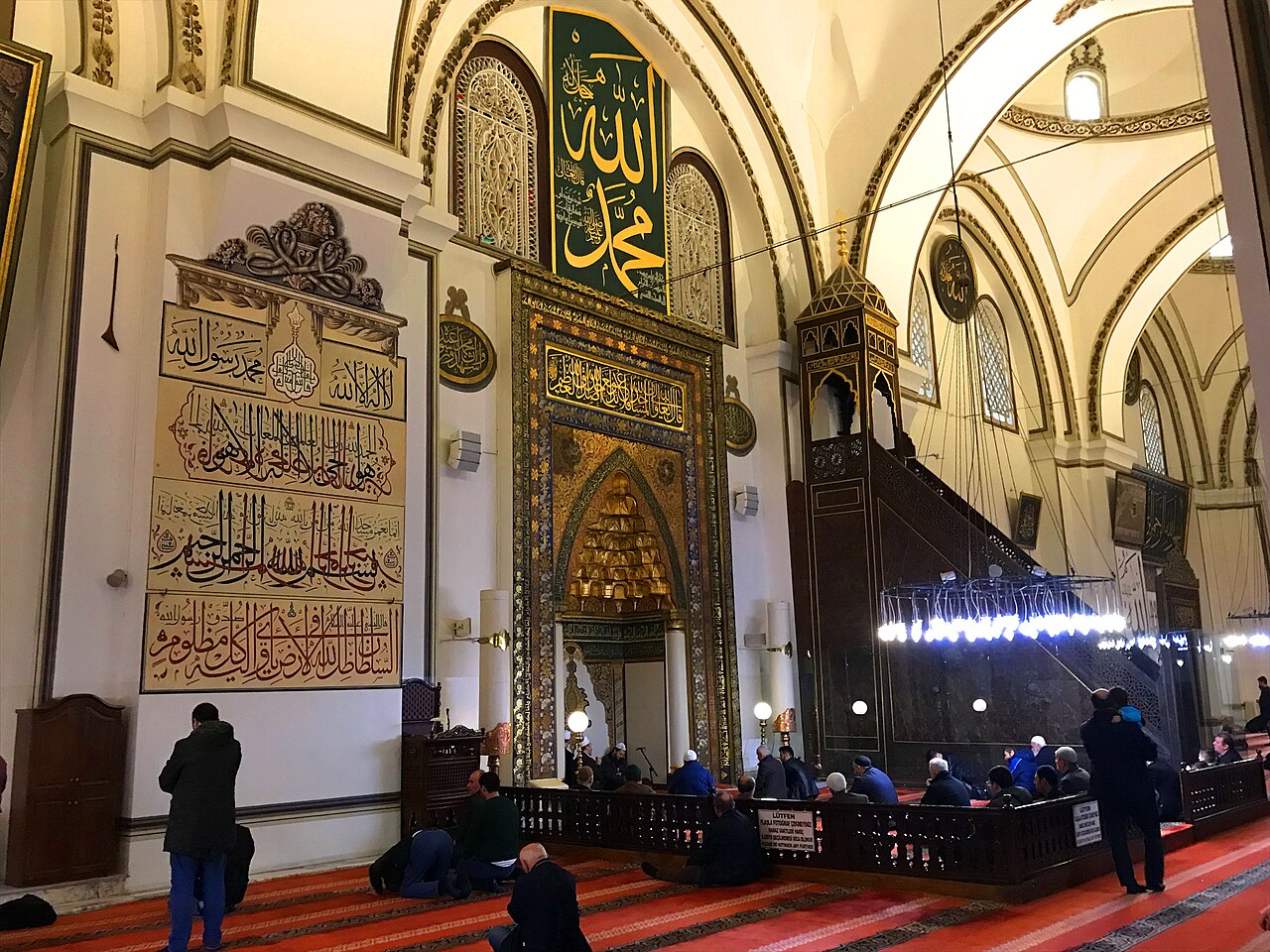
- Why is it important? It stands as one of the early monuments of Ottoman architecture, distinguished by its two lateral portals, the mirrored “Allah Hû” calligraphic inscription, and its 1399-dated kündekârî minbar (detailed below). [1]
Sources emphasize that the ornamentation and the hat (Islamic calligraphic art) inscriptions adorning the two lateral gates of the Bursa Grand Mosque were crafted with meticulous precision [1]. The monument also features an area decorated with the double “Allah Hû” inscription [1].
Representing one of the large-scale examples of early Ottoman architecture [1], this edifice serves not merely as a place of worship, but also presents a cross-section of artistic and artisanal history. The architectural and decorative richness of the monument is prominently displayed in details such as its two side portals and its minbar [1].
Where is it?
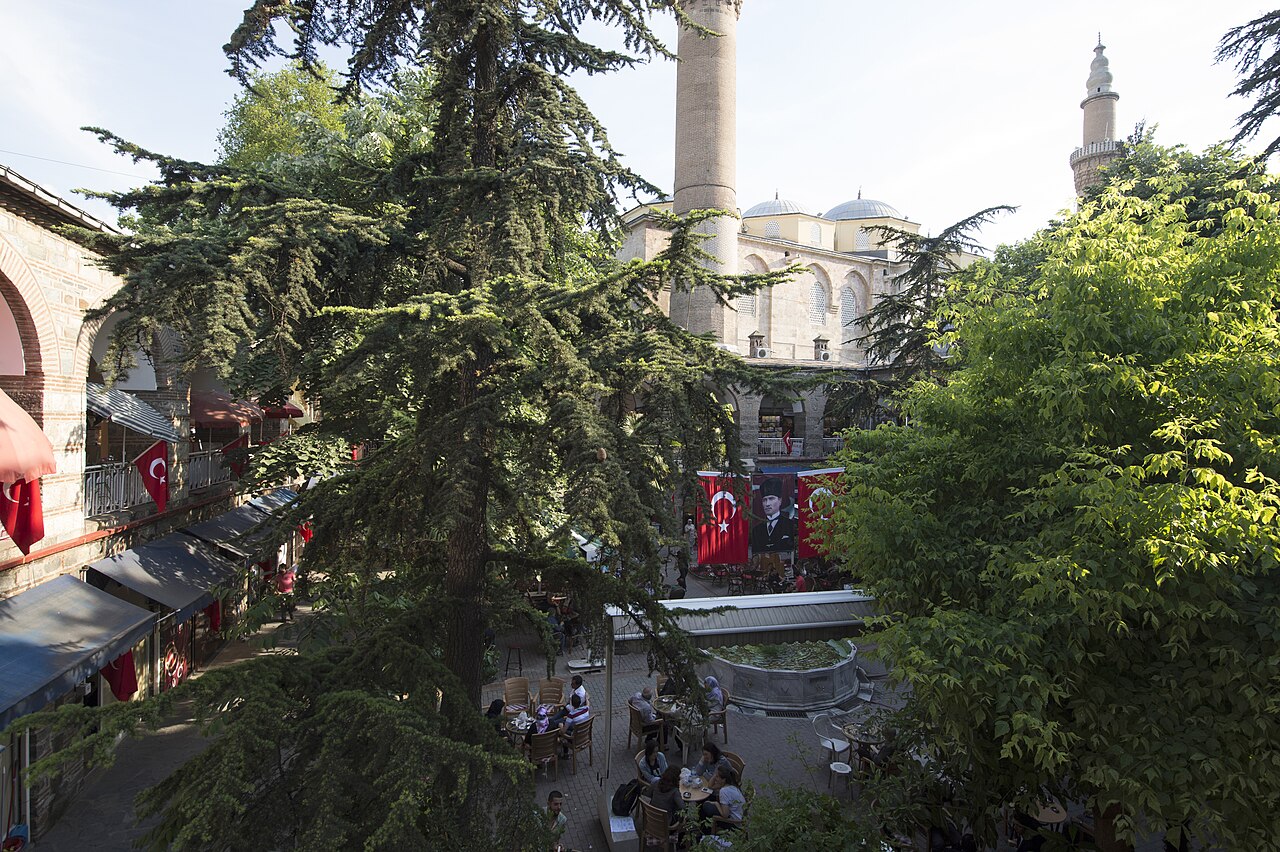
The Bursa Grand Mosque is situated in northwestern Turkey, at the heart of the provincial center of Bursa in the Marmara Region [1]. It lies in close proximity to the city’s historical bazaar and a district densely populated with other Ottoman-era monuments. This central setting allows visitors the convenience of exploring multiple historic sites within a single walking route [1].
Throughout history, Bursa served as a major crossroads for caravan trade routes. Particularly during the Middle Ages, commercial routes connecting Anatolia to Rumelia and Europe passed directly through Bursa [3]. Consequently, the construction of the Grand Mosque can be viewed as an architectural enterprise reflecting the city’s strategic standing. The mosque shares the same geographic and historical setting with the Yıldırım Madrasa and Mount Uludağ.
Bursa’s geological framework also influenced the stone materials utilized in the mosque’s construction. The city was shaped by the İzmir–Ankara suture zone, formed by the subduction process of the Tethys Ocean situated between the Sakarya Zone of the Pontides and the Tavşanlı Zone of the Anatolide–Tauride Block [3]. This geological setting influenced the stone materials employed in the construction of the mosque, which derived from local volcanic (magmatic rocks originating from volcanic activity) and metamorphic (rocks altered under high temperature and pressure) formations found across Bursa (such as the Uludağ Massif).
History & Origins
While exact dates concerning the initial foundation and earliest phases of the Grand Mosque are not explicitly detailed in the source, a working chronology can be inferred from the dates associated with its two side portals and minbar. According to the source, the calligraphic inscriptions and ornamental motifs on the two lateral gates bear the distinct hallmarks of the early Ottoman era [1]. Furthermore, the minbar housed within the mosque was crafted in 1399 using the kündekârî technique [2][1]. These records indicate that the building’s construction and ornamental programs date back to the late 14th century.
The mosque’s designation as “Ulu” (grand) can be interpreted as an indication of its religious and civic stature during that era [1].
Following the rise of the Ottoman State, Bursa became its first capital city. Thus, the erection of the Grand Mosque mirrored the city’s role as a political and religious epicenter. In addition, restorations supervised by Ahmed Vefik Pasha in the 19th century added further value to the mosque in the modern era [1]. Ahmed Vefik Pasha made significant efforts to preserve and restore Bursa’s historic monuments. During this campaign, the Grand Mosque, alongside other mosques, was restored and reopened for worship [1].
The urban renewal and conservation initiatives initiated with Ahmed Vefik Pasha’s appointment as governor of Bursa aimed directly at preserving the city’s historical heritage. During this period, the mosque underwent restoration not only for its kündekârî-crafted minbar, but also in terms of its stonework and decorative details [1].
Architectural Form
The Bursa Grand Mosque exhibits the characteristic features of early Ottoman architecture. The inscriptions above the structure’s two lateral portals reflect the period’s mastery of calligraphy (the art of Islamic handwriting) [1]. Positioned atop these doorways is the mirrored “Allah Hû” inscription—a decorative element emphasizing the sanctity of the prayer hall. The expression “Allah Hû” is a supplicatory phrase in Arabic meaning “God is present,” and its dual inscription indicates that it is visually repeated twice.
Within the interior, the 1399 minbar (the elevated platform from which the imam delivers the sermon) takes center stage. The minbar was fabricated using an intricate woodworking technique known as kündekârî, wherein geometric pieces such as octagons, pentagons, and stars are interlocked without glue or nails to form flat, durable surfaces [2][1]. Kündekârî aligns the wood grains (fibers) in opposing directions to prevent warping and cracking, thereby ensuring the exceptional longevity of the minbar. The motifs on the minbar are typically enriched with arabesque (flowing vegetal and geometric patterns) ornament and mother-of-pearl inlays (lustrous decorative accents formed by delicately embedding fragments of seashell) [2][1].
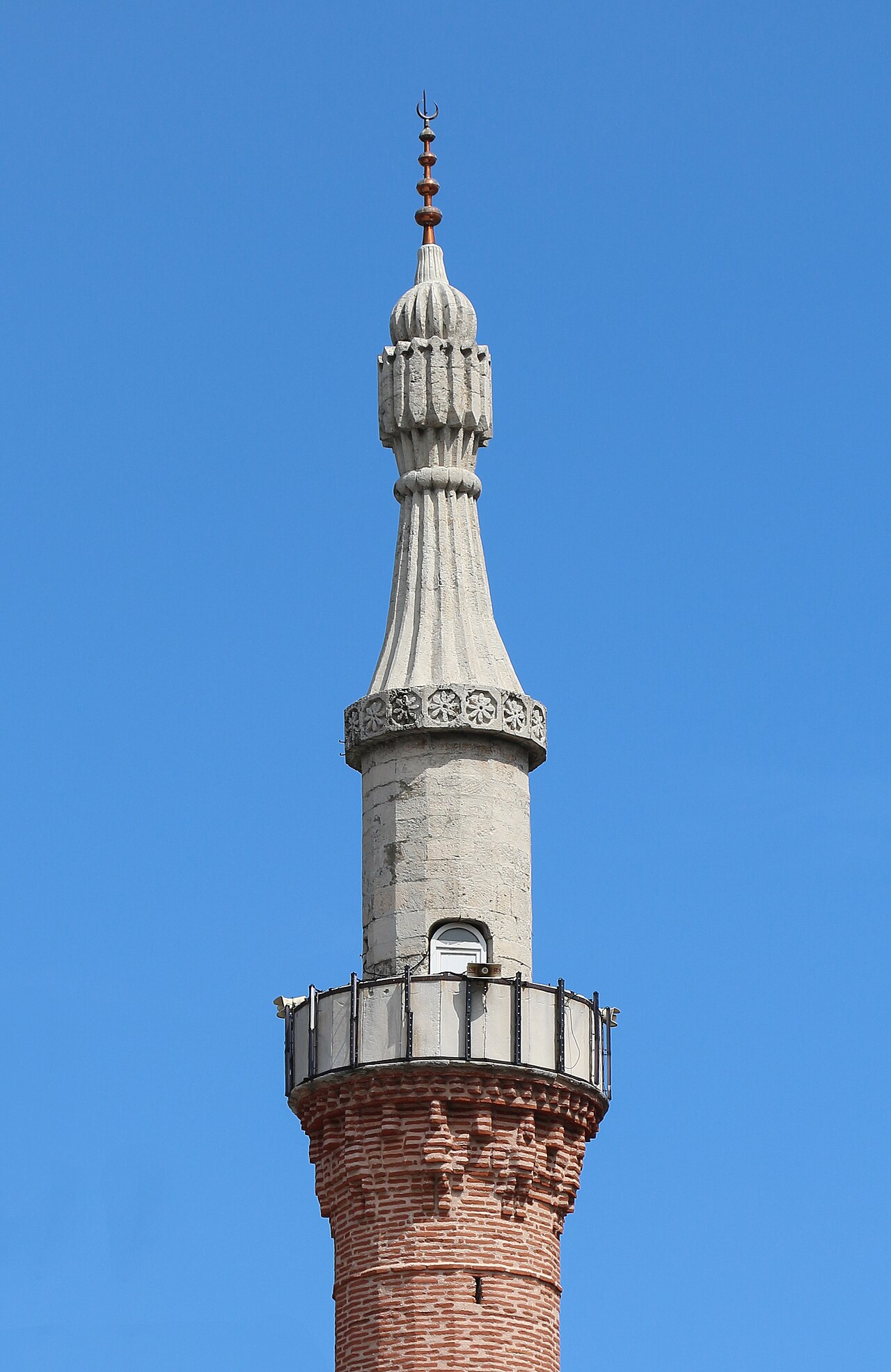
The mosque’s overarching architecture can be characterized as a composition where stone and wood elements unite in harmonious coherence. The ashlar stonework gracing the exterior facade exemplifies standard traits of Ottoman architecture. The stones were precisely cut and tightly fitted together, endowing the monument with both aesthetic balance and structural durability [1].
The interior spatial organization follows traditional layout principles found in Ottoman architectural design. The mezâlî (elevated preaching platform) and the minbar occupy central positions within the sanctuary, providing a functional arrangement that facilitates congregational rituals [1].
Much like the kündekârî technique, the mosque’s stonework details demanded rigorous planning. The stones were custom-dressed and meticulously aligned to maintain the architectural integrity of the sanctuary [1]. These refined details serve as prime exemplars of the art of stonemasonry (kaleme) in Ottoman architecture.
Visiting Notes
- Getting there: Because the mosque is situated in central Bursa, it is accessible via public transportation and on foot; however, detailed driving or transit directions are not provided in the source. Please consult official local guides to verify current route details.
- Highlights: The calligraphic panels on the two side portals, the mirrored “Allah Hû” inscription, and the 1399 kündekârî minbar represent the most prominent features of the mosque [1][2].
- Visitor etiquette: As the mosque is an active place of worship, silence should be maintained during visiting hours and respect shown to worshipers; this is a customary rule of etiquette for religious sanctuaries and is not explicitly specified in the source. Verify current visiting rules prior to your visit.
- Nearby historical sites: The mosque is located near historical landmarks such as the Yıldırım Madrasa, Mount Uludağ, and Bursa Castle. Visiting these sites together offers a broader perspective on the city’s cultural heritage [1].
- Local events: Historical walking tours and cultural festivals held in Bursa can enrich a visit to the Grand Mosque. Travelers should consult local tourism information offices or online platforms for event schedules [1].
References
- [1] Arama - TDV İslâm Ansiklopedisi – “Ulu Camii – Bursa”. https://islamansiklopedisi.org.tr/ulu-cami—bursa
- [2] KÜNDEKÂRÎ - TDV İslâm Ansiklopedisi. https://islamansiklopedisi.org.tr/kundekari
- [3] Bursa İlinin (KB Türkiye) Önemli Jeositleri / Significant Geosites in Bursa Province (NW Türkiye) – Hükmü Orhan, Aral İ. Okay, Nizamettin Kazancı (2026).
Additional Notes
The architecture of the Bursa Grand Mosque was also shaped by the city’s geological environment. Bursa was formed along the İzmir–Ankara suture zone, which developed as a result of the subduction process of the Tethys Ocean (a geological term used in the source referring to geological changes resulting from sea level fluctuations) located between the Sakarya Zone of the Pontides and the Tavşanlı Zone of the Anatolide–Tauride Block [3]. This geological setting influenced the stone materials utilized in the mosque’s construction, derived from the local volcanic (formed from magma extruded by volcanoes) and metamorphic (rocks altered under extreme heat and pressure) formations (such as the Uludağ Massif) found throughout Bursa.
The mosque’s architecture reflects both the region’s geological characteristics and its cultural values. Consequently, the Grand Mosque stands not merely as a sanctuary of worship, but as an integral constituent of Bursa’s historical and natural heritage.
Konum
Harita: © OpenStreetMap katkıcıları. Haritada büyüt · Google Haritalar · Apple Haritalar
İşaret yaklaşık konumu gösterir; kesin konum için yerel kaynaklara bakın.
This article is compiled from scholarly monographs and official architectural inventories. Please verify site access conditions, visiting hours, and ongoing conservation status via official heritage authorities prior to visiting.