
October 2026
Overview
- A historic place of worship located within the archaeological site of Ani, distinguished by its polychrome stone decorations and octagonal minaret [1].
- Situated in eastern Turkey, within the boundaries of Kars Province, on the edge of the Arpaçay valley [1], [2].
- Considered one of the earliest mosques built following the Turkish conquest of Anatolia, it is under UNESCO protection [1].
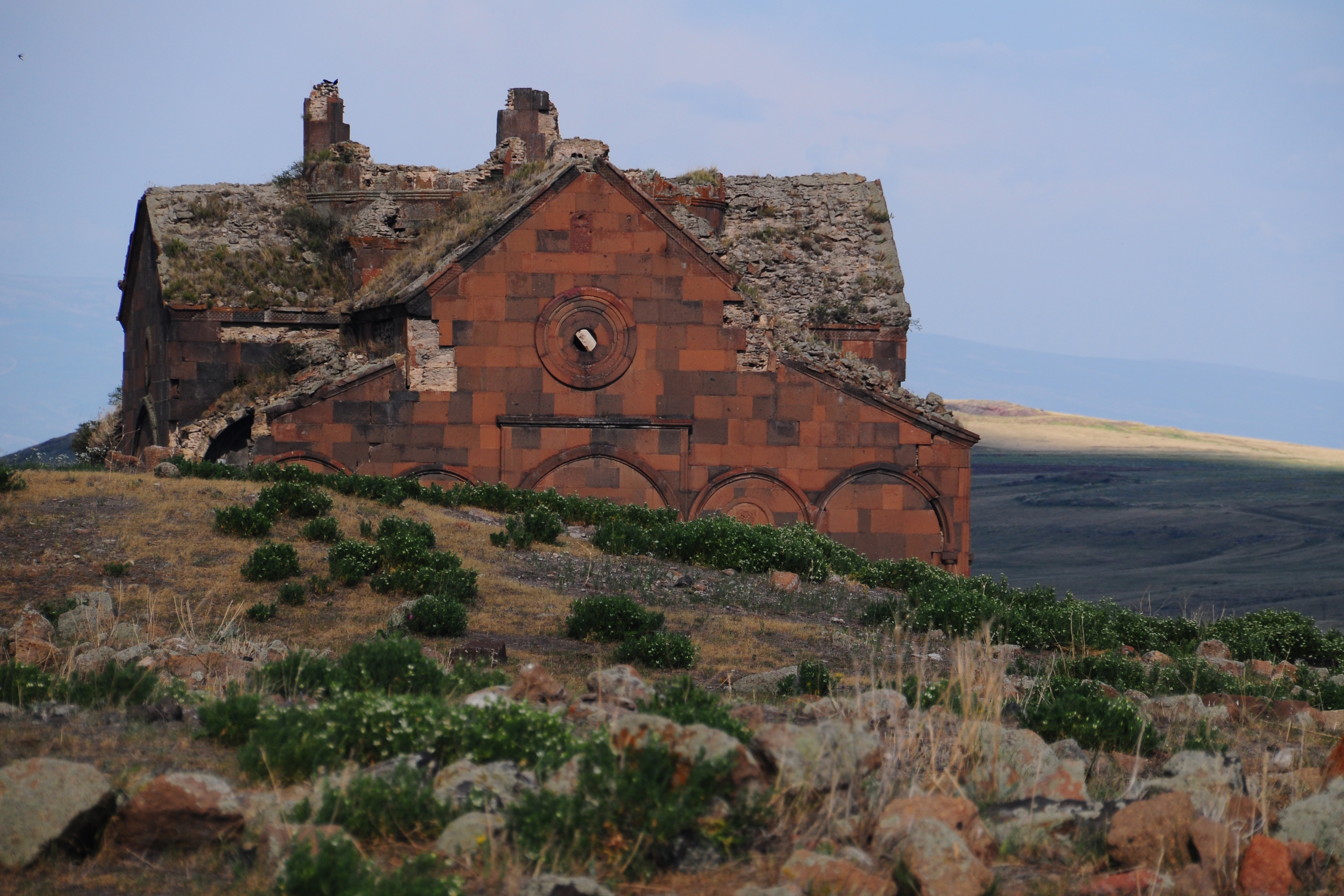
Set amid the ruins of the Ani archaeological site, the Menuchehr Mosque is an exceptional monument bearing the accumulation of centuries [1], [2]. Reflecting the rich heritage inherited from Eastern Anatolia’s past, this edifice, together with the surrounding stone structures, reflects the historical legacy of the region [1], [2].
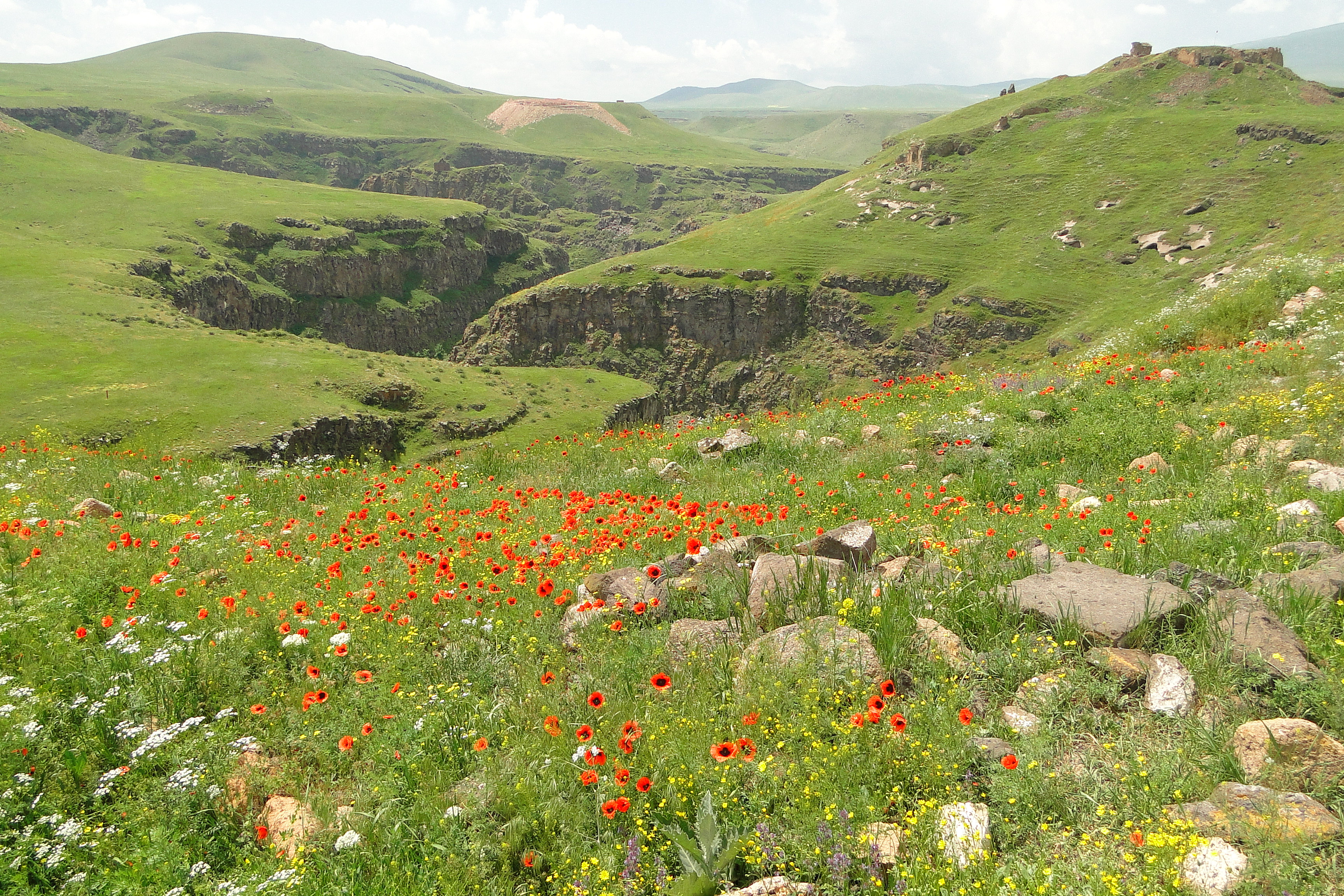
The mosque is situated in close proximity to the sheer cliffs running along the Arpaçay Canyon [1], [2]. The monument stands upon the expansive terrain of the ancient city [1], [2]. The architectural details presented by this edifice reflect the shared traces of the diverse civilizations that have traversed the region [1], [2].
Having survived down to the present day despite undergoing numerous transformations over time, this monument stands today as a significant historic structure for cultural heritage enthusiasts [1], [2]. It is one of the notable examples with its sturdy stone walls and distinctive octagonal minaret [1].
Where is it?
The Menuchehr Mosque is located within the borders of the central district of Kars Province in Turkey’s Eastern Anatolia Region [1]. However, the structure is not situated within the city center itself [2]. The mosque stands on the grounds of the famed Ani archaeological site established along the Arpaçay valley [2].
The geographic coordinates of the mosque are recorded in sources as 40°30′19″ north latitude and 43°34′12″ east longitude [1]. The historic city of Ani, within which the mosque stands, extends across a broad area at coordinates 40°30′ north and 43°34′ east [2].
The monument is surrounded by an exceedingly rich urban fabric that was established and destroyed throughout history [2]. The city of Ani sits atop an elevated plain—namely a plateau—flanked to the east and west by the deep Arpaçay Canyon [2].
The city’s third facade, facing the plateau, is defended by formidable city walls dating to the 10th century [2]. Access to this historic city is gained through the main gateway known as the Lion Gate (Aslanlı Kapı) [2]. The ramparts feature figurative restoration motifs including lions, dragons, and double-headed eagles [2].
The mosque is an integral part of this deeply rooted center, historically acclaimed as the “city of a thousand and one churches” and the “city of forty gates” [2]. Furthermore, beneath the city’s ground level lies an extraordinarily vast subterranean city comprising no fewer than 823 structures and caves [2].
As part of the Archaeological Site of Ani, the Menuchehr Mosque was inscribed on the UNESCO World Heritage List in 2016 [1], [2]. This international protected area encompasses a designated archaeological site of 250.7 hectares [2]. In addition, it includes a 432-hectare buffer zone protecting the monument and its environs [2].
In the immediate vicinity of the mosque stand ancient defensive walls, the Cathedral of the Virgin Mary, and 8 surviving church structures [2]. Thus, the mosque rests both on the precipitous slope of a natural canyon and at the very heart of an intense cultural stratigraphy spanning centuries [2].
History & Origins
The history of the mosque is directly intertwined with the tumultuous millennia-long past of the city of Ani [1], [2]. The city of Ani is a deeply rooted settlement tracing back to the Iron Age, namely between 1200 and 1000 BCE [2].
During the era of the Urartians, who ruled in the Iron Age, the region was known as Akhuriani [2]. Later, in the 4th century BCE, during the period of the Orontid Dynasty, it passed under Armenian rule [2]. By the 6th century, the city had become a fortified stronghold belonging to the Kamsarakan clan [2]. The phrase “fortified stronghold” here describes protected fortress settlements reinforced with thick ramparts and defensive bastions to shield against hostile attacks [2]. It was this very fortified settlement that the Bagratuni Dynasty acquired in 780 [2].
In 961, the Bagratid ruler Ashot III transferred the kingdom’s capital here [2]. Following this relocation, the city experienced the most illustrious days of its history [2]. However, the Byzantines brought an end to the city’s independent rule in 1045 [2]. Immediately thereafter, Ani was conquered in 1064 by the Seljuk Sultan Alp Arslan [2].
Following the conquest, Ani and its environs were ceded to the Shaddadid Principality, a Muslim dynasty of Kurdish origin subordinate to the Great Seljuk Empire [1], [2], [3]. The Shaddadid dynasty had been established in 951 [3]. In 1072, the principality established an emirate centered at Ani, maintaining its presence here until 1199 [3].
Turkish sources state that the mosque was commissioned by Menuchehr ibn Shavur [1]. Sources cite the construction date across two different time ranges: some sources point to between 1072 and 1086, while others indicate between 1072 and 1092 [1].
According to this premise, the structure is cited among the first mosques constructed within the borders of modern-day Turkey following the Turkish conquest of Anatolia [1]. The monument is also referred to in sources as the “Kars Ani Grand Mosque” (Kars Ani Ulu Camii) and is categorized within the group of congregational (ulu) mosques [1].
Nevertheless, sources are not in full consensus regarding the original function and origins of the building [1]. Certain researchers and foreign sources suggest that the structure was originally a palace building [1].
According to other claims, it was a former customs house or a catholicosate building [1]. A catholicosate denotes the see and administrative center of the supreme religious leader, namely the patriarch, within the hierarchy of the Armenian Church [1]. Other researchers, meanwhile, contend that the building was an annex to a destroyed earlier church [1].
It is also debated whether the structure might have been one of the assembly halls known in Armenian church architecture as a jamatun [1]. A jamatun refers to a large domed or vaulted vestibule built adjoining the western entrance of churches, utilized for religious ceremonies and prayers as well as accommodating secular assemblies of the congregation, burials, and waiting areas [1].
Around 1190, the city of Ani, where the mosque is located, passed under the control of the Georgian nobleman Zakare Mkhargrdzeli [2]. During this era, the city was governed by atabegs subordinate to the Georgian monarchs [2]. Subsequently, governance fell into the hands of atabegs subject to the Mongol Ilkhanids [2].
The city of Ani suffered devastating damage in the major earthquake of 1319 [2]. It was subsequently devastated by the armies of Timur [2]. Ultimately, the city was entirely abandoned by its inhabitants during the Ottoman-Safavid War of 1535 [2].
Steps have been taken in recent times for the mosque structure, which had long remained in a ruined state [1]. Under a protocol signed with the Serhat Development Agency in 2022, the mosque was restored, reinstated for daily prayer, and the five-daily call to prayer (adhan) was resumed [1].
Architectural Form
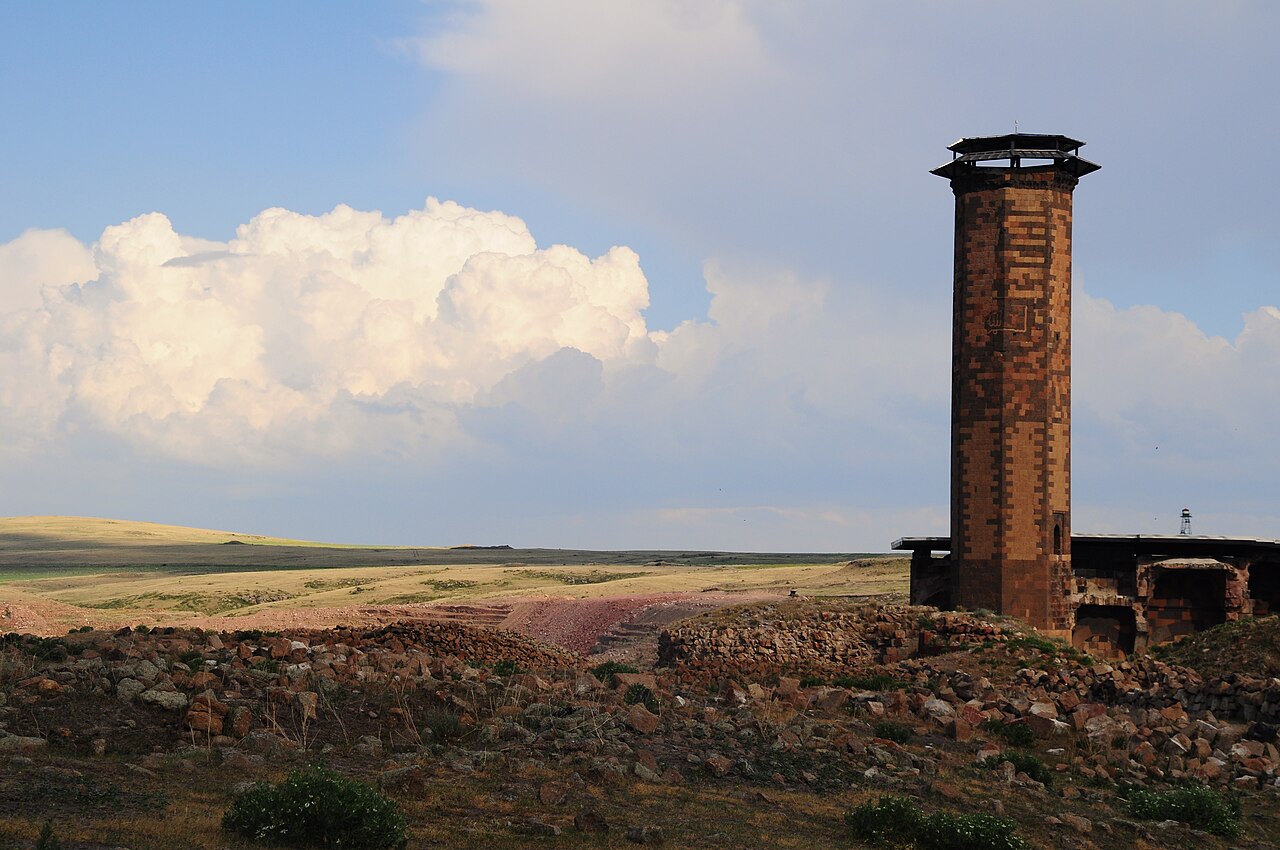
Viewed from the exterior, the Menuchehr Mosque is a robust structure distinguished by its stone texture and soaring minaret [1]. The primary material utilized in its construction is polychrome stone, which imparts a rich dynamism to both the facades and the interior [1].
According to sources, bays supported by columns are situated within the harim of the mosque [1]. The harim designates the primary interior sanctuary in mosques where the congregation gathers for communal prayer and worship [1]. This colonnaded arrangement is striking on both the floor level and the ceilings of the structure [1]. The ceiling bays feature geometric embellishments and patterns created through the masterful juxtaposition of polychrome stones [1].
These richly colored and patterned ceilings are among the architectural elements that immediately capture the attention of those entering the edifice [1]. Inside, the columns supporting the ceiling are aligned to facilitate a harmonious union of the stone vaults [1]. A vault is a curved and arched stone ceiling covering formed by a continuous sequence of arches, resembling a tunnel or barrel roof [1]. These vaulted stone coverings in the structure endow the interior with a sense of depth and spaciousness [1].
The most prominent element of the monument, however, is the octagonal-shafted minaret rising toward the sky right beside it [1]. This eight-sided minaret is recognized as one of the rare surviving specimens of early Turkish architecture in Anatolia [1].
According to scholarly evaluations, this octagonal minaret form is likened to the architectural style employed during the Karakhanid period in Central Asia [1]. Indeed, certain sources suggest that the minaret might even predate the existing body of the mosque [1].
Photographic documentation reveals an inscription of “Allah” carved in relief stonework on the stone shaft of the minaret [1]. An informational plaque is mounted at its entrance [1].
The Lost Trilingual Inscription
One of the most fascinating details shedding light on the mosque’s history is the trilingual inscription once located on its western wall [1]. This inscription was not composed in a single tongue [1]. The epigraph was arranged side-by-side in three distinct languages: Persian, Georgian, and Armenian [1].
The inscription dates to the year 1238 of the Gregorian calendar [1]. The text was first documented by the French scholar Marie-Félicité Brosset in the 1860s [1].
Later, the Georgian scholar Nicholas Marr identified this stone anew during his 1909 excavations and surveys [1]. According to sources, however, this invaluable inscription is no longer in situ today and remains lost [1].
In the Persian portion of the inscription, the year 635 AH is recorded [1]. This corresponds to 1237 or 1238 in the Gregorian calendar [1]. Within this line, the phrase “the sinner, Zikéria son of the deceased” can be deciphered [1].
The Georgian section, comprising the upper two lines, states that Atabeg Zakaria ratified this on the date of “Konikon 458” [1]. The Konikon refers to the traditional 532-year calendar cycle and chronological reckoning system utilized by the Georgians throughout the Middle Ages [1]. The date Konikon 458 in the Georgian text corresponds precisely to the year 1238 of the Gregorian calendar [1].
In the single-line Armenian portion at the very bottom, there is a benediction reading, “May the Lord be pleased with those who keep watch over this” [1].
Bringing together these three distinct languages, the inscription suggests that the building may have continued to be protected by different cultures and rulers in the post-Seljuk eras as well [1], [2].
Visiting Notes
The Menuchehr Mosque is situated within the extensive grounds of the Ani archaeological site in Kars Province [1], [2]. Departing from central Kars, it is possible to reach this impressive open-air museum in the direction of Arpaçay [2].
The first systematic archaeological excavations in the region were conducted during the Tsarist Russian period [2]. These digs were carried out between 1892 and 1918 [2]. In subsequent periods, excavation efforts were maintained by domestic researchers under the leadership of the Kars Museum and Kafkas University [2].
Following extensive refurbishments in 2022, the edifice was reopened for worship, and the five-daily call to prayer is regularly recited within [1]. Sources note that visitors can view the building’s interior, particularly during prayer times [1].
Current opening hours, admission fee schedules, and public transportation options to the site are not provided in the source documentation [1], [2]. It is therefore advisable to verify up-to-date visiting hours and terms via official channels before setting out.
As visitors will be walking along the precipice of a deep canyon and across a windswept plateau, paying heed to weather conditions will be particularly beneficial [2]. While exploring the rich historical heritage of Ani, this mosque stands as one of the essential must-see stops [1], [2].
References
- [1] Menûçihr Camii - Vikipedi, https://tr.wikipedia.org/wiki/Ebu%27l_Menu%C3%A7ehr_Camii
- [2] Ani - Vikipedi, https://tr.wikipedia.org/wiki/Ani
- [3] Şeddâdîler - Vikipedi, https://tr.wikipedia.org/wiki/%C5%9Eedd%C3%A2d%C3%AEler
Konum
Harita: © OpenStreetMap katkıcıları. Haritada büyüt · Google Haritalar · Apple Haritalar
İşaret yaklaşık konumu gösterir; kesin konum için yerel kaynaklara bakın.
This article is compiled from scholarly monographs and official architectural inventories. Please verify site access conditions, visiting hours, and ongoing conservation status via official heritage authorities prior to visiting.