
October 2026
Overview
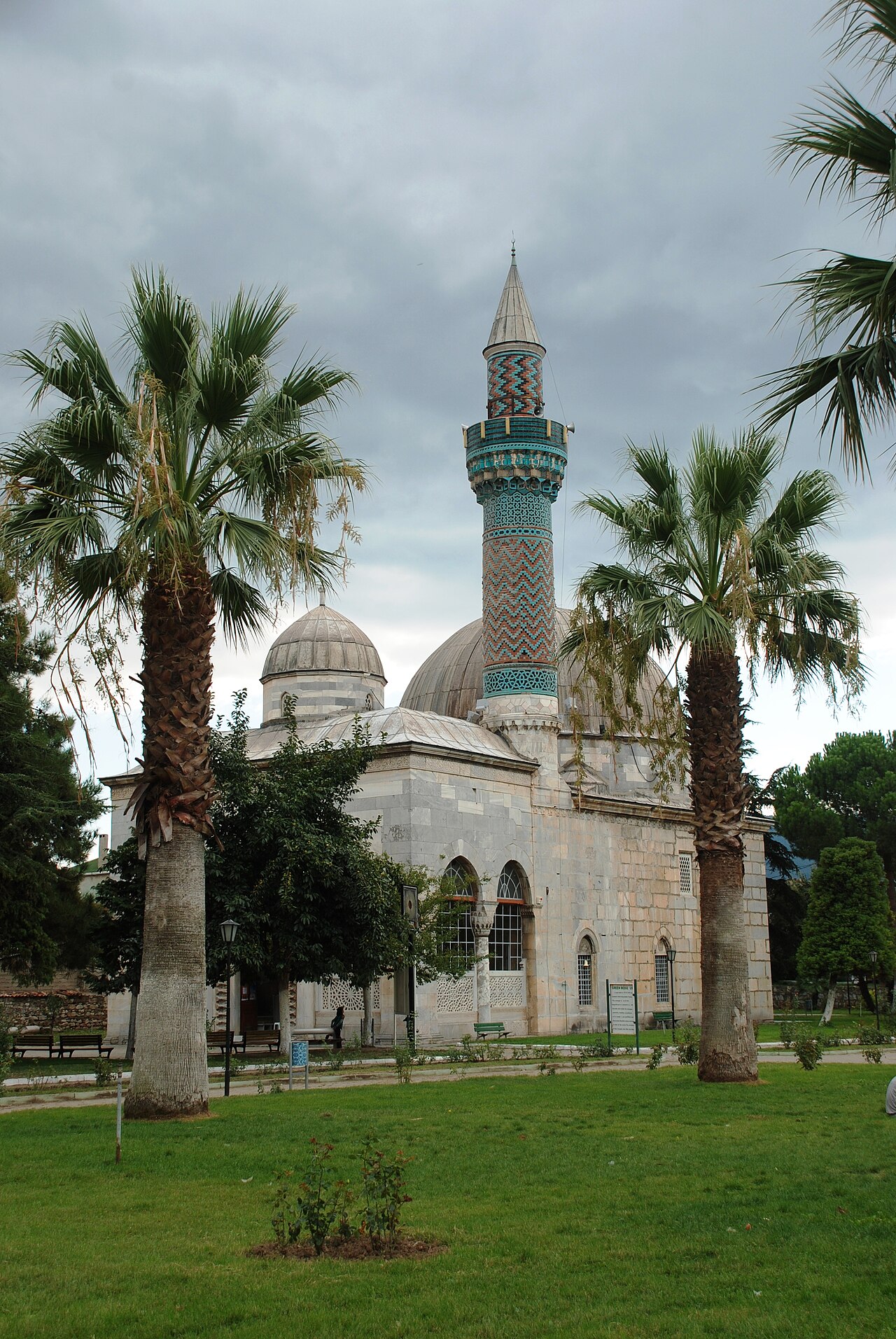
- What: An early-period mosque bearing the hallmarks of Seljuk architecture, taking its name from the colorful ornamentations adorning its minaret [2].
- Where: Located in the historically rich district of İznik, within the province of Bursa [1].
- Why it matters: It stands out for its glazed tile (ceramic tile) decorations, refined stonework, and “octagonal stone finials” (eight-sided stone ornaments mounted atop roofs, domes, or minarets) [1], [2].
Having hosted diverse cultures throughout history, İznik was further enriched during the Ottoman era with remarkable early-period monuments [1]. Situated within the town, the Green Mosque (Yeşil Cami) ranks among the most prominent structures distinguished by the colorful compositions on its minaret [2]. This mosque represents an authentic monument conveying the design sensibility and geometric decorative aesthetic of the early era to the present day [2]. Within the structure, stone craftsmanship and the art of glazed tilework were applied in unison [2].
In the following sections, the building’s location, dating, architectural elements, and decorative nuances are presented directly in light of documented written sources [1], [2].
Where is it?
The Green Mosque is situated within the boundaries of the İznik district in the province of Bursa [1]. İznik was captured by Turkish forces in 1331, subsequently becoming a key center of Ottoman administration [1].
The town expanded through the earliest Ottoman madrasa (an Islamic educational institution) and numerous public charitable endowments (large-scale constructions erected for the public benefit) [1]. Renowned landmarks cited in historical records, such as the Hagia Sophia Mosque and the Nilüfer Hatun Imaret (a building commissioned by Nilüfer Hatun, generally denoting a civic structure such as a madrasa, bathhouse, or related public establishment), are located within this core [1].
The monumental fabric surrounding the mosque directly mirrors the urban planning principles of the early Ottoman period [1]. The monument forms an integral part of a settlement endowed with dense historical strata [1].
As İznik remains one of the seminal crossroads of Anatolia’s cultural heritage, the Green Mosque—together with the historic monuments in its vicinity—is regarded as one of the focal points of this historic setting [2].
History & Origins
Historical sources record that a statesman (a high-ranking administrative dignitary) played an instrumental role in the construction and completion of the building [2]. According to the study by Hülya Bozyokuş, a Pasha (an Ottoman military and administrative title; here designating a high-ranking commander who oversaw the ongoing construction) carried forward the building process and brought the mosque to completion [2].
In the records of the TDV Encyclopedia of Islam, the construction date of the İznik Green Mosque is given as 794 (1391–92) [1]. The monument represents the architectural hallmarks of the Seljuk era in Anatolia from both historical and structural standpoints [2].
Although constructed during the Ottoman period, it incorporates the artistic traditions and stylistic ethos of Seljuk craftsmanship [2].
While definitive archival details regarding the full construction process remain limited, the mosque embodies the distinctive traits of the architectural evolution of its era [1], [2]. The spatial composition of early Ottoman architecture and traditional decorative conventions coalesce harmoniously within this edifice [2].
Architectural Form
General Architecture and Minaret Layout
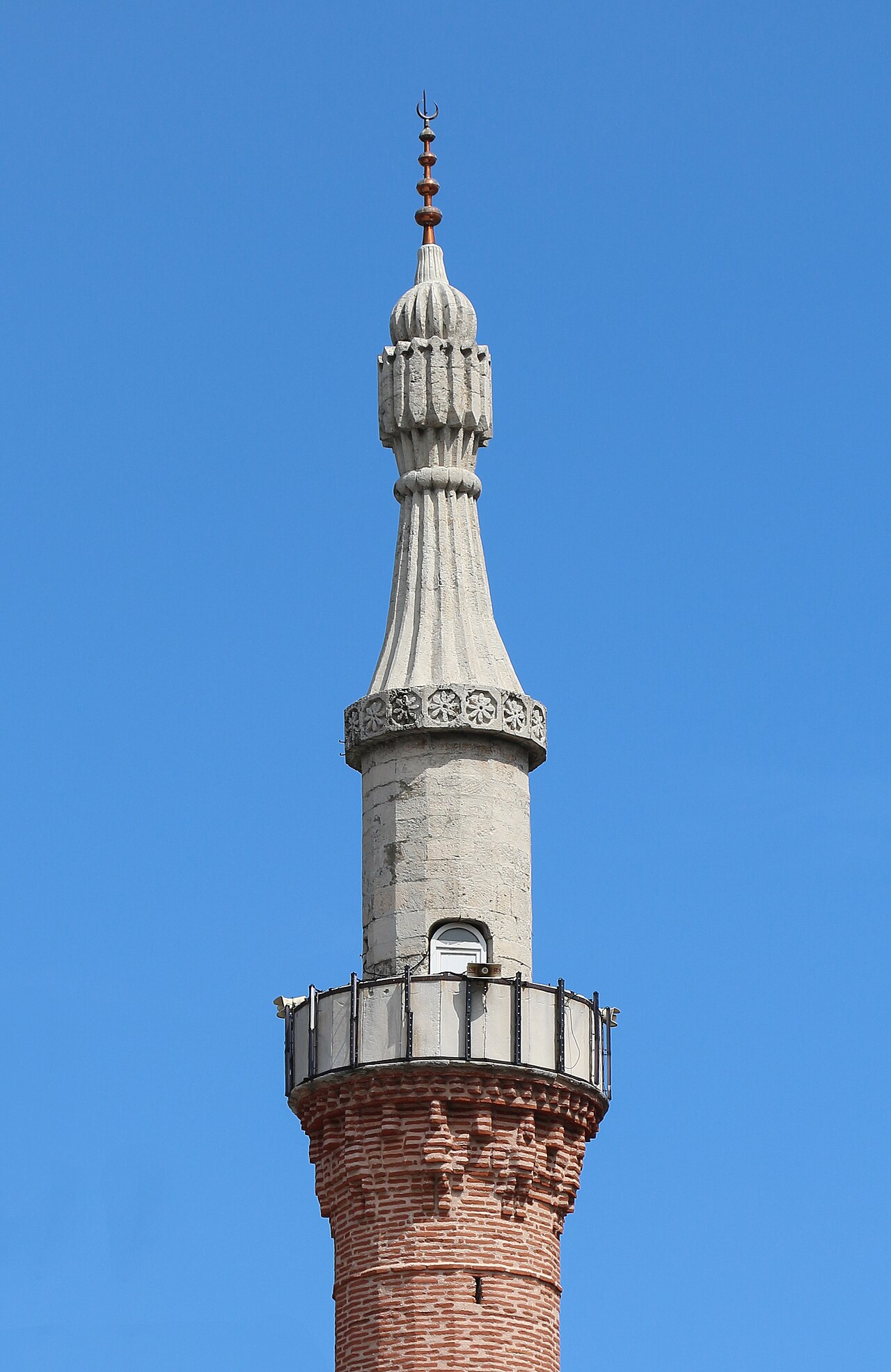
In the assessment of researchers, the geometric forms incorporated into the mosque’s architecture carry paramount structural significance [2]. The minaret rises skyward from a base (the platform situated at the foot of the minaret, typically square or rectangular in plan, constituting its foundation) positioned at the northwestern corner of the primary prayer hall [2].
The minaret rests upon a square plinth, with its shaft commencing in the form of a polygonal prism (a three-dimensional solid with multiple facets, possessing a polygonal base whose planes extend parallel to each other) [2]. As it ascends, this shaft gradually transitions into a circular form [2].
The summit of the minaret culminates in a single balcony (a single-tiered, one-level balcony) and a conical cap (a tapering, pointed roof covering) [2]. The balcony (şerefe) denotes the projecting, balustraded gallery utilized when proclaiming the call to prayer [2]. The cap (külah), on the other hand, is the pointed conical spire enclosing the highest apex of the minaret [2].
According to data documented in the TDV Encyclopedia of Islam, octagonal stone finials (eight-sided ornamental stones mounted atop roofs or minarets) crown the summit of the İznik Green Mosque [1]. A finial (alem) is a symbolic decorative ornament placed at the apex of structures such as roofs, domes, or spires [1]. These octagonal stone finials represent rare and noteworthy survivals among early-period specimens [1].
Stonework and Stalactite Details
The stonework across the minaret is elevated to an art form through marble embellishments [2]. In particular, by utilizing stalactite-carved marble (stone carved in the manner of stalactites, imparting a tiered, corbelled relief), decorative treatments were executed in semi-hexagonal (segments forming half of a six-sided figure) profiles [2].
A stalactite (muqarnas) is a tiered, projecting stone ornament shaped like cascading stalactites (stone suspended from an upper ceiling or wall surface), employed in Islamic architecture as a structural transitional element or sculptural adornment [2]. These semi-hexagonal marble segments serve as aesthetic components that give the minaret its stepped, multifaceted profile [2].
A meticulous transitional scheme was orchestrated between the stone carving and the glazed tile surfaces; this configuration is noted for adding profound depth both to the exterior silhouette and to the monumental character of the edifice [2].
Within the carved stone decorations, zigzag interlacings (patterns creating sharp, V-shaped zigzagging meanders) and geometric lines (linear, angular, or circular delineations) interact in profound harmony [2]. The symmetry exhibited across these stone faces reflects the aesthetic canons of early Anatolian Turkish art [2].
Tiles and Geometric Decorative Scheme
Between the stone reliefs and the shaft collar band (an architectural moulding encircling the minaret shaft in the manner of a horizontal belt or band) situated upon the minaret’s cylindrical shaft (a tall section extending with a circular cross-section like an elongated cylinder), vivid glazed tiles (ceramic tiles, typically executed in blue-green hues and enriched with geometric patterns) were set [2].
These tiles are composed of turquoise (light blue-green) and cobalt/lapis lazuli (deep blue-green / dark blue) tones, articulating an exclusive ornamental composition [2]. At the exact center of this decorative program, six-pointed stars (six-sided star motifs) are arranged in continuous succession [2].
The monument features a rich repertoire of geometric figures, including triangles, pentagons, hexagons, octagons, and star polygons (multi-pointed star forms) [2]. The symmetry of the motifs, the zigzag interlacings, and the harmony of the ceramic texture accentuate its visual grandeur [2].
According to scholars, geometric forms (lines, geometric figures, and patterns) have been employed throughout human history to indirectly symbolize emotions and contemplative concepts, thereby establishing an abstract “universal language” [2]. The interior and exterior ornamentations of the İznik Green Mosque perpetuate this symbolic universal language [2].
Visiting Notes
To closely examine the octagonal stone finials and the glazed tile bands encircling the minaret, daylight hours are recommended [1], [2]. During your visit, you can observe the polygonal configuration at the minaret base as well as the turquoise tiles beneath the collar band [2].
Situated at the heart of İznik, this monumental edifice is an essential destination for those seeking an intimate understanding of the early Ottoman era [1], [2]. Incorporating the site into an itinerary alongside the town’s other early-period monuments provides a thoroughly rewarding historical and cultural excursion [1].
References
- [1] Arama - TDV İslâm Ansiklopedisi, https://islamansiklopedisi.org.tr/yesil-cami—iznik
- [2] İZNİK YEŞİL CAMİ ÇİNİLERİNE GEOMETRİK BAKIŞ — Hülya Bozyokuş (2018, DergiPark (Istanbul University)), https://dergipark.org.tr/tr/pub/ijhar/issue/55202/758259
Konum
Harita: © OpenStreetMap katkıcıları. Haritada büyüt · Google Haritalar · Apple Haritalar
İşaret yaklaşık konumu gösterir; kesin konum için yerel kaynaklara bakın.
This article is compiled from scholarly monographs and official architectural inventories. Please verify site access conditions, visiting hours, and ongoing conservation status via official heritage authorities prior to visiting.