

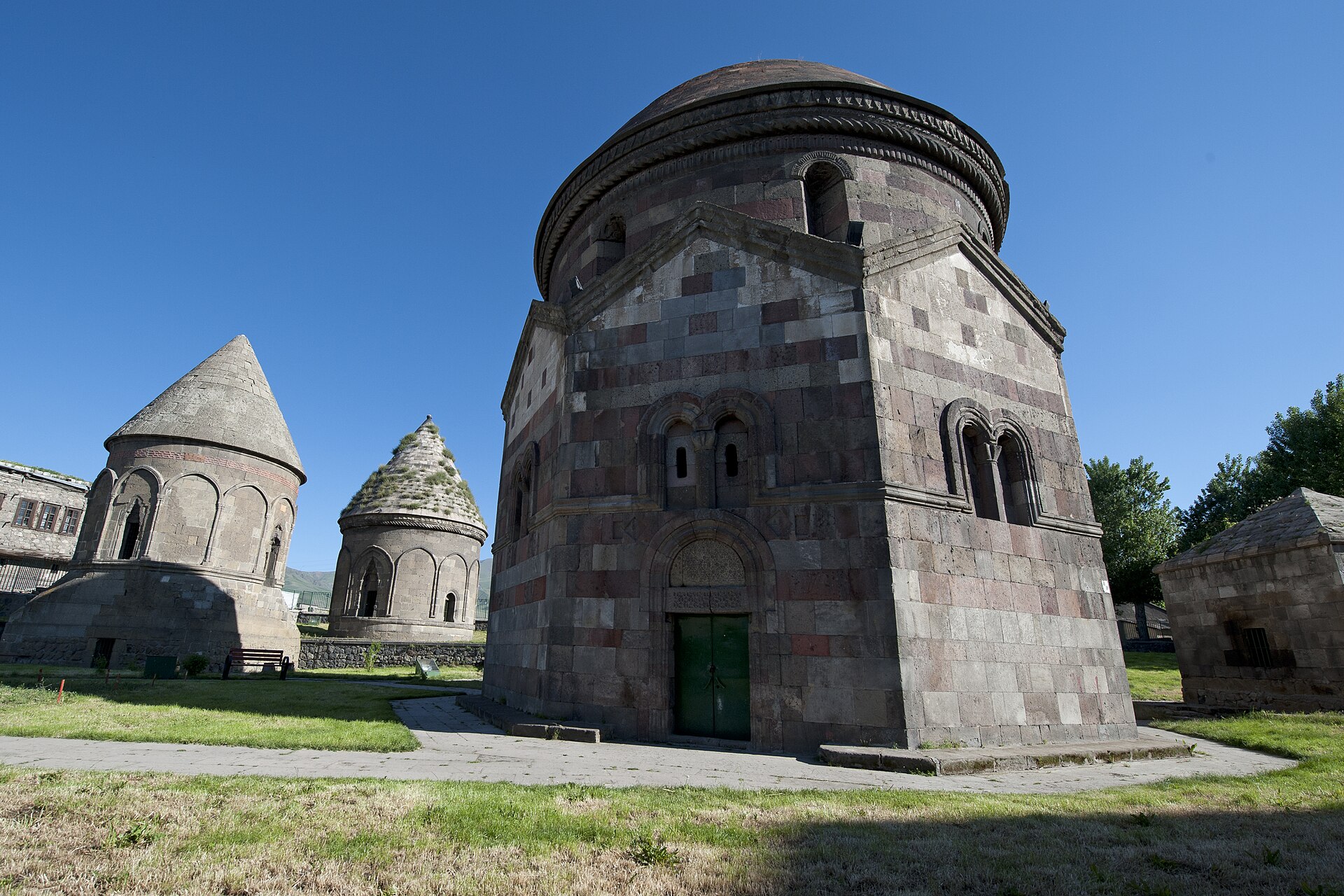

Summary
- What is it? A funerary monument with a subterranean chamber for mummification, surmounted by a cylindrical or polygonal body and covered internally by a dome and externally by a conical or pyramidal cupola [2].
- Where is it found? Across a broad geography stretching from Iran to Azerbaijan, Harezm to Anatolia [2].
- When? The earliest referenced example dates to the early 11th century (Kümbed-i Kābûs, 1006–1007); the tradition persisted in Anatolia until the late 19th century [2].
- How is it read? Three elements suffice: base, body, and cover [1].
What Is a Kümbet?
According to the TDV İslâm Ansiklopedisi, a kümbet is a funerary monument consisting of a cylindrical or polygonal body resting on a subterranean chamber for mummification, covered internally by a dome and externally by a conical or pyramidal roof [2]. The chamber for mummification is the lower space where the deceased was placed. In contrast, a türbe directly buries the deceased in the ground, with the structure typically square or polygonal in plan and domed [2].
The key distinction between the two lies not in the shape of the body but in the funerary structure’s placement within the building. This differentiation is often obscured in colloquial usage; this text will explicitly distinguish between the two.
Origins: Tent or Tower?
A prominent hypothesis regarding the origins of kümbets attributes them to the architectural adaptation of Turkic tents, as proposed by Josef Strzygowski [2]. While widely accepted, this remains a speculative theory rather than definitive knowledge.
The earliest surviving examples are found in Iran. The Kümbed-i Kābûs in Cürcân (1006–1007) is tower-like with a dynamic exterior of pointed protrusions; though referred to as a kümbet, it does not fully align with later typologies [2]. During the Great Seljuk period, the Çihilduhterân in Damgan (1054–1055) represents an early example with a brick cylindrical body, while the Kümbed-i Ali near Eberkûh (1056–1057) is constructed of stone [2].
Anatomy: Base, Body, Cover
The Culture and Tourism Ministry’s Cultural Portal categorizes this reading into three sections [1]:
- Base. Most commonly square; in the Cimcime Hatun Kümbet in Erzurum, the base is cylindrical, while the Ikiz Kümbetler in Van feature an octagonal base.
- Body. Cylindrical (Cimcime Hatun), octagonal (Emir Saltuk), dodecagonal (Halime Hatun, Şah Cihan Hatun), or a baldaquin-like structure with eight columns (Ikiz Kümbetler).
- Cover. Internally typically domed; externally conical cupola, pyramidal cupola, or arch.
Two additional elements may be added: spatial arrangement (in two-story structures, the upper level may function as a mosque, as in the Ulu Kümbet in Ahlat [1]) and inscriptions; for many kümbets, the date of construction and the identity of the deceased are often conveyed through epigraphic bands.
Body Types
- Cylindrical body. Dominant in Great Seljuk kümbets [2]; persists in Anatolia (e.g., Cimcime Hatun) [1].
- Polygonal body. Later examples with numerous sides appear in Azerbaijan and western Iran; most Anatolian kümbets are stone-built, two-story structures with polygonal bodies [2]. Examples include octagonal (Emir Saltuk) and dodecagonal (Halime Hatun, Şah Cihan Hatun) forms [1].
- Square plan. Emerges in Anatolia only after the 13th century [2]; a square-plan structure is noted near the Üç Kümbetler in Erzurum [3].
- Baldaquin. Eight-columned, open-body structures; exemplified by the Ikiz Kümbetler in Van [1].
- Ahlat type. Cylindrical body with a muqarnas cornice and conical roof: Ulukümbet, Hasan Padişah, and Çifte Kümbet are examples of this typology [2].
- Segmented body. In the Mama Hatun Kümbet in Tercan, the square base transitions to an octagonal form, with segmented body and cupola; surrounded by a circular wall with thirteen niches. This plan has few parallels in Anatolia [4].
Decoration and Inscriptions
Decoration often defines the identity of certain kümbets. The Şah Cihan Hatun Kümbet in Kayseri is adorned with geometric panels, Rumi motifs, human head reliefs, and tree-of-life patterns [5]. A band of cursive script from Surah Al-Fath’s first thirteen verses encircles the Halime Hatun Kümbet in Gevaş [1]. Beneath the eaves of the Ulu Kümbet in Ahlat are muqarnas and a band inscribed with Ayet al-Kursi [1]. The Emir Saltuk Kümbet in Erzurum features two-colored stone, paired windows, and niche reliefs depicting animal-plant motifs [3].
Thus, approaching a kümbet, decoration functions not as mere ornamentation but as an interpretive tool: what does the epigraphic band state? Are there figural elements? For whom was it constructed?
Materials
Brick is prevalent in Iran; stone largely supplants it in Anatolia. Glazed bricks and tiles are also encountered in decorative contexts [2]. In Anatolia, stone itself becomes a narrative device: two-colored stone is used in the Emir Saltuk Kümbet [3].
Geography
The map below indicates locations of some structures referenced in this text. While not exhaustive, it illustrates the breadth of the tradition’s geographic spread.
- Iran. Kümbed-i Kābûs, Çihilduhterân, Kümbed-i Ali, and Se Kümbet (1184) in Urmiye [2]; we discuss the structure in Urmiye in our article on Üç Günbed Türbesi.
- Azerbaijan. Yûsuf b. Küseyr (1162) and Mümine Hatun (1186) kümbets in Nahçıvan; Kümbed-i Surh (1147) and Kümbed-i Kebûd (1196) in Merağa [2].
- Harezm and Turkmenistan. A kümbet dedicated to Fahreddin er-Râzî in Ürgenç (1208) and the Yartı Kümbet near Serahs [2].
- Anatolia. A broad arc stretching from Erzurum, Ahlat, and Gevaş through Kayseri, Konya, and Niğde [1], [2].
Harita
Harita: © OpenStreetMap katkıcıları. Bu yazıda anılan bazı yapılar ve kendi yazıları:
- Kümbed-i Kābûs, Gonbad-e Kavus (Iran)
- Üç Günbed (Se Gonbad), Urmiye (Iran)
- Mümine Hatun Kümbeti, Nahçıvan (Azerbaijan)
- Halime Hatun Kümbeti, Gevaş (Van)
- Emir Bayındır Kümbeti, Ahlat (Bitlis)
- Üç Kümbetler, Erzurum
- Döner Kümbet (Şah Cihan Hatun), Kayseri
- Mama Hatun Kümbeti, Tercan (Erzincan)
- Ulu Kümbet (Usta Şakirt), Ahlat (Bitlis)
- İkiz Kümbetler, Van
- Cimcime Hatun Kümbeti, Erzurum
- Alemşah Kümbeti, Sivrihisar (Eskişehir)
Timeline
- 1006–1007: Kümbed-i Kābûs in Cürcân [2].
- 1054–1057: Çihilduhterân and Kümbed-i Ali during the Great Seljuk period [2].
- 12th century: Examples in Azerbaijan and western Iran (Nahçıvan, Merağa, Urmiye) [2]; in Anatolia: II. Kılıçarslan Kümbet (Konya, before 1192) and Gevher Nesibe (Kayseri, 1205–1206) [2]. The Emir Saltuk Kümbet in Erzurum is dated to the second half of the 12th century [3].
- 13th century: Huand Hatun (Kayseri, 1238) and Ahlat-type examples [2]; Döner Kümbet dated to the late 13th century [5].
- 14th century: Hudâvend Hatun (Niğde, 1312, Ilkhanid period) and Halime Hatun (Gevaş, 1358) [2].
- 15th century: Erzen Hatun (1396–1397) and Emîr Bayındır in Ahlat [2].
- 18th century: The Ikiz Kümbetler in Van are thought to date to this period [1].
- Ottoman period: The türbe form becomes dominant; the kümbet tradition persists until the late 19th century [2].
Why Do Dates Differ?
In many kümbets, construction inscriptions are absent or illegible, leading to estimated dates based on architectural analysis. This results in minor discrepancies among sources. For example, one source cites the Döner Kümbet as dating to “around 1275” [1], while the TDV article places it at the end of the 13th century and notes that the date 1276 lacks foundation [5]. The Emîr Bayındır Kümbet in Ahlat is dated by the Culture Portal to 1481, whereas the general TDV entry cites 1491 [1], [2]. For Ulukümbet, one source provides 1273 [2], while another notes no inscription and estimates a 13th-century date [1].
Thus, in this guide, dates are presented as stated by a single source; detailed comparisons of inscriptions and sources will be addressed individually in each kümbet article.
Reading a Kümbet on Site
- First, examine the base: square, cylindrical, or octagonal?
- Next, observe the body: how many sides? What material? Where is the decoration concentrated?
- Then, assess the cover: conical, pyramidal, or domed?
- Search for an epigraphic band: if absent, the date is speculative; if present, it identifies the deceased.
- Finally, consider the surrounding context: is the structure part of a külliye (e.g., Mama Hatun) or a necropolis? Old photographs near the Üç Kümbetler suggest an ancient necropolis now transformed into a park [3].
Series
Each kümbet in this series has its own dedicated article detailing the structure’s plan, decoration, inscriptions, and sources. Links to these articles will be added as they are published.
Visit Notes
- Accessibility conditions for each site may vary; check with the relevant provincial culture and tourism office before visiting.
- The map coordinates are approximate; some kümbets now lie within urban areas, parks, or neighborhoods.
References
- [1] “Witnesses of History: Tombs (Kümbet)” — T.C. Culture and Tourism Ministry, Cultural Portal — https://www.kulturportali.gov.tr/portal/tarihin-taniklari-kumbetler
- [2] “Kümbet” entry, Sema Doğan — TDV İslâm Ansiklopedisi — https://islamansiklopedisi.org.tr/kumbet
- [3] “Üç Kümbetler” entry — TDV İslâm Ansiklopedisi — https://islamansiklopedisi.org.tr/uc-kumbetler
- [4] “Mama Hatun Külliyesi” entry — TDV İslâm Ansiklopedisi — https://islamansiklopedisi.org.tr/mama-hatun-kulliyesi
- [5] “Döner Kümbet” entry, Özkan Ertuğrul — TDV İslâm Ansiklopedisi — https://islamansiklopedisi.org.tr/doner-kumbet
This article is compiled from scholarly monographs and official architectural inventories. Please verify site access conditions, visiting hours, and ongoing conservation status via official heritage authorities prior to visiting.