

Summary
- Structure: Monumental caravanserai with the classical sultan han plan schema of the Anatolian Seljuk period [1, 2].
- Location: Situated along the historical Kayseri-old Malatya route within Karadayı village, Elbaşı district, Bünyan province [1, 2].
- History and Builder: According to historical records and waqf inscriptions, the caravanserai was founded by Celâleddin Karatay [1]. The portal section was completed during the reign of Sultan I. Alâeddin Keykubad, while the courtyard complex was finalized under Sultan II. Gıyâseddin Keyhusrev in 638 AH (1240-41) [1].
- Plan Layout: Composed of a large courtyard section with surrounding spaces and an enclosed hall behind it [1]. The main walls are supported by eighteen towers, six at the corners [1].
- Portal and Figures: The projecting courtyard portal features two lions, two nude women, bull and human heads; corner pilasters depict birds and lions; niche panels contain sirens, winged lions, and seated human figures [1].
- Interior Spaces: Includes a 13-meter entrance iwan with fifteen animal-relief fountain iwan, prayer kiosk with call-to-prayer tower, earth-pipe hamam, and seven-niche enclosed hall [1].
Location
Karatay Han is located within Karadayı village, Elbaşı district of Bünyan province along the historical Kayseri-old Malatya route [1, 2]. The caravanserai’s main walls and vaulted roof system are entirely clad in precisely cut stone [1]. Massive stone walls are reinforced by eighteen towers, six at the corners [1].
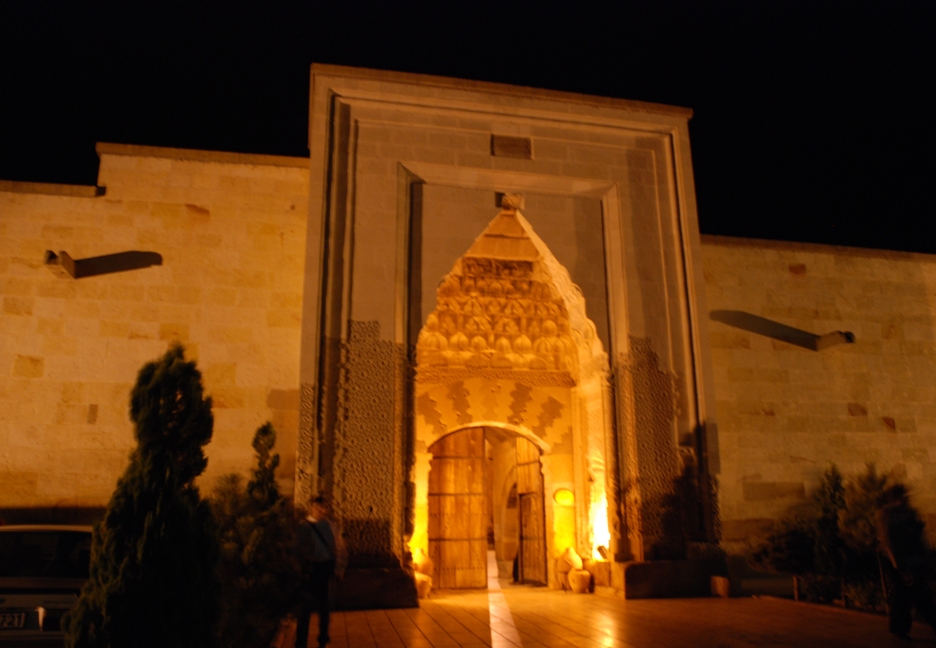
The entrance façade features clustered piers with star-shaped corner towers, while other sides display triangular, octagonal, square, and circular-section towers [1].
History
Commissioned by Celâleddin Karatay, one of Anatolia’s leading Seljuk statesmen, Karatay Han represents a significant example of sultan caravanserai architecture [1]. According to inscriptions on the structure, the entrance section was completed during Sultan I. Alâeddin Keykubad’s reign, while the courtyard complex was finalized under Sultan II. Gıyâseddin Keyhusrev in 638 AH (1240-41) [1].
The waqf-endowed caravanserai functioned as a comprehensive waystation designed to ensure security, accommodation, and provisions for travelers and caravans [1, 2].
Architectural Features
Karatay Han follows the classical Seljuk sultan caravanserai plan schema of the early 13th century, featuring an open courtyard with enclosed sections [1].
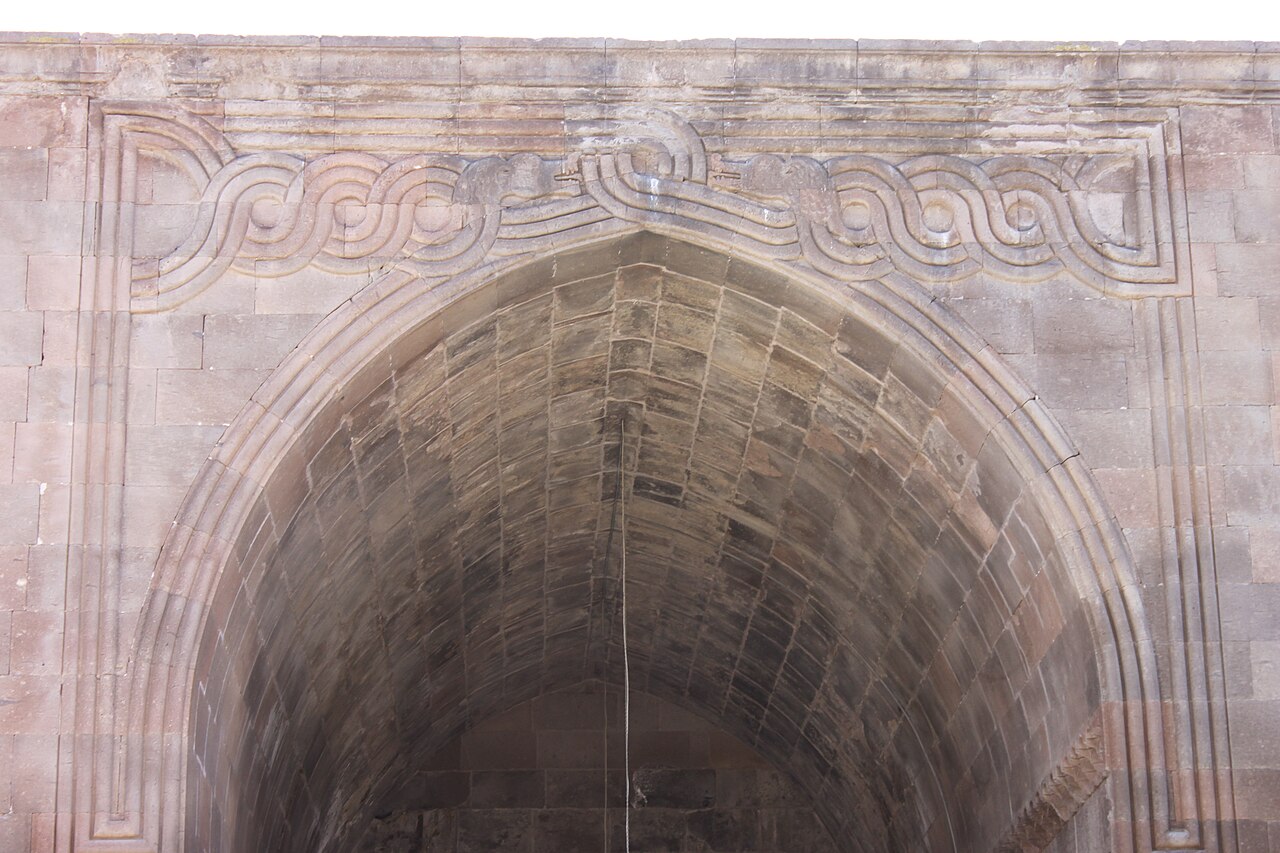
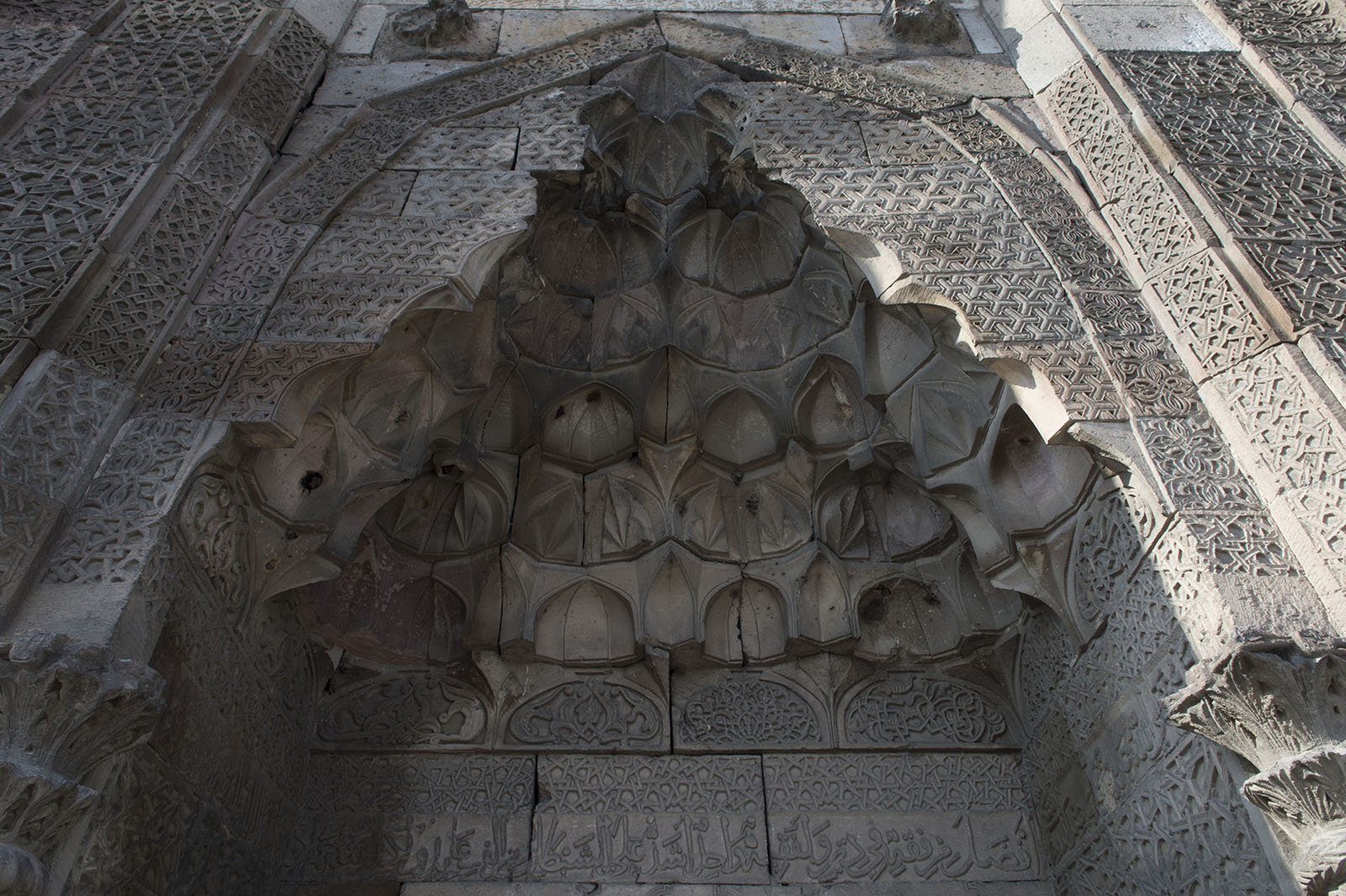
- Courtyard Portal and Shamanic Symbols: The projecting courtyard portal, elevated above the façade, is adorned with geometric and vegetal motifs alongside human and animal reliefs [1]. These figures carry symbolic meanings rooted in Central Asian shamanic traditions as protective and fertility symbols [1]. At one end of the muqarnas corbeling border are two facing lions and two nude women; at the other end, stacked bull and human heads [1]. The corner pilasters feature bird and lion reliefs on their outer faces, while the inner panels of niches contain two sirens within rûmî scrolls [1]. One of the two portals on the entrance façade depicts a winged lion, the other shows seated humans between two bull reliefs [1].
- Entrance Iwan and Fifteen Animal-Relief Fountain: To the left of the 13-meter entrance iwan is a specialized space group resembling the nearby Hızır İlyas Pavilion, with a star-vaulted fountain iwan later repurposed as a tomb [1]. The fifteen small animal reliefs on the fountain iwan’s arch include elephant, lion, bull, dragon, bird, and hare figures [1]. The entrance iwan’s courtyard-facing arch is framed by a knot motif terminating in dragon heads [1].
- Mosque and Call-to-Prayer Kiosk: The domed section opposite the entrance iwan constitutes the caravanserai’s mosque [1]. The geometric and vegetal-bordered mosque door faces the courtyard; adjacent steps lead to a defensive wall with an opening serving as the call-to-prayer kiosk [1].
- Hamam Section: Access to the hamam is via a corridor from the mosque’s eastern side [1]. The hamam’s furnace opens directly into the main walls, distributing hot water through earthen cisterns across three rooms within the walls [1].
- Enclosed Hall and Seven-Niche Layout: The enclosed winter hall (hol) behind the courtyard is organized with seven longitudinal vaulted naves [1]. The lateral naves, covered with pointed barrel vaults, are intersected perpendicularly by a higher central nave [1]. Along one courtyard wall are arcaded porticoes (revak); on the opposite side, vaulted enclosed chambers are arranged [1].
Visit Notes
Karatay Han is located in the center of Karadayı village, Bünyan. Accessible via the Kayseri-Malatya highway, the structure features cut-stone architecture and courtyard portals that can be viewed from outside or within during open hours.
For clear visibility of the lion, bull, human, and siren reliefs on the courtyard portal and the fifteen animal figures in the fountain iwan, visit during midday and afternoon when direct sunlight illuminates these carved details.
No visitation hours or access conditions are specified in available sources.
References
- [1] Karatay Hanı — TDV İslâm Ansiklopedisi (Şebnem Akalın Eryavuz, Vol. 24, 2001, pp. 415-416) — https://islamansiklopedisi.org.tr/karatay-hani
- [2] Karatay Hanı — Kayseri İl Kültür ve Turizm Müdürlüğü — https://kayseri.ktb.gov.tr/TR-54854/karatay-hani.html
Konum
Harita: © OpenStreetMap katkıcıları. Haritada büyüt · Google Haritalar · Apple Haritalar
İşaret yaklaşık konumu gösterir; kesin konum için yerel kaynaklara bakın.
This article is compiled from scholarly monographs and official architectural inventories. Please verify site access conditions, visiting hours, and ongoing conservation status via official heritage authorities prior to visiting.
,_Schlangenportal_Innenseite.jpg)